
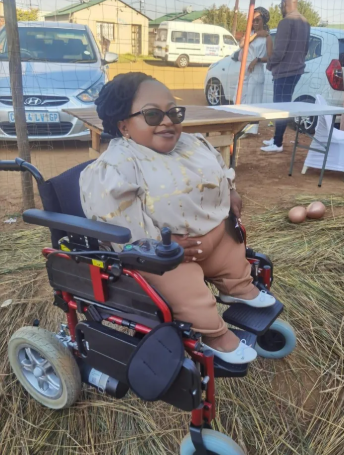
This Women’s Month, one story that stands out is that of Lungi Mkwani, a 27-year-old woman from Kagiso, near Krugersdorp, who lives with osteogenesis imperfecta (OI)—a rare genetic condition commonly known as brittle bone disease. Despite the challenges of living with a condition that makes her bones fragile and prone to fractures, Lungi refuses to let her circumstances define her.
A Journey of Resilience
Armed with a qualification in Public Relations (N4), call center training, and experience in business and office administration, Lungi has worked hard to position herself for employment opportunities. Yet, like many women with disabilities in South Africa, she continues to face barriers to entering the workplace.
“Living with a disability as a woman in South Africa is challenging,” Lungi shared in a recent interview. “Most of our cries are rarely heard.” Her words echo the struggles of countless women with disabilities who face not just physical barriers, but also societal prejudice and systemic exclusion.
More Than Just a Personal Story
Lungi’s situation speaks to a broader reality: the intersection of gender and disability often creates multiple layers of discrimination. While she is skilled, motivated, and ready to contribute, the lack of inclusive hiring practices and accessible work environments holds her back.
This isn’t about ability—it’s about access.
Support and Advocacy
Organizations like Afrika Tikkun are stepping in to address these gaps. Through skills development, mentorship, and advocacy, they work to create inclusive pathways for young people with disabilities. Their programs—ranging from vocational training in fields like hospitality and farming, to support groups and disability pageants—highlight the need for holistic support.
Afrika Tikkun emphasizes that inclusive hiring must go beyond being a checkbox exercise; it needs to be a genuine commitment by employers to treat disabled candidates as valuable contributors.
Why Lungi’s Story Matters
- Representation matters. Lungi’s visibility challenges stereotypes about what people with disabilities can achieve.
- Policy gaps remain. South Africa has progressive laws on paper, but enforcement and implementation often fall short.
- Community power. Advocacy groups and support systems are crucial in bridging the gap between talent and opportunity.
A Call to Action
Lungi’s story is not just one of struggle—it’s also one of hope. It reminds us that the fight for equality and inclusion is ongoing, and that each of us has a role to play. Employers must re-examine their hiring practices, policymakers must strengthen enforcement, and society at large must shift perceptions about disability.
As Lungi herself demonstrates, capability is not the issue—opportunity is.
With accessibility and inclusion at heart,